

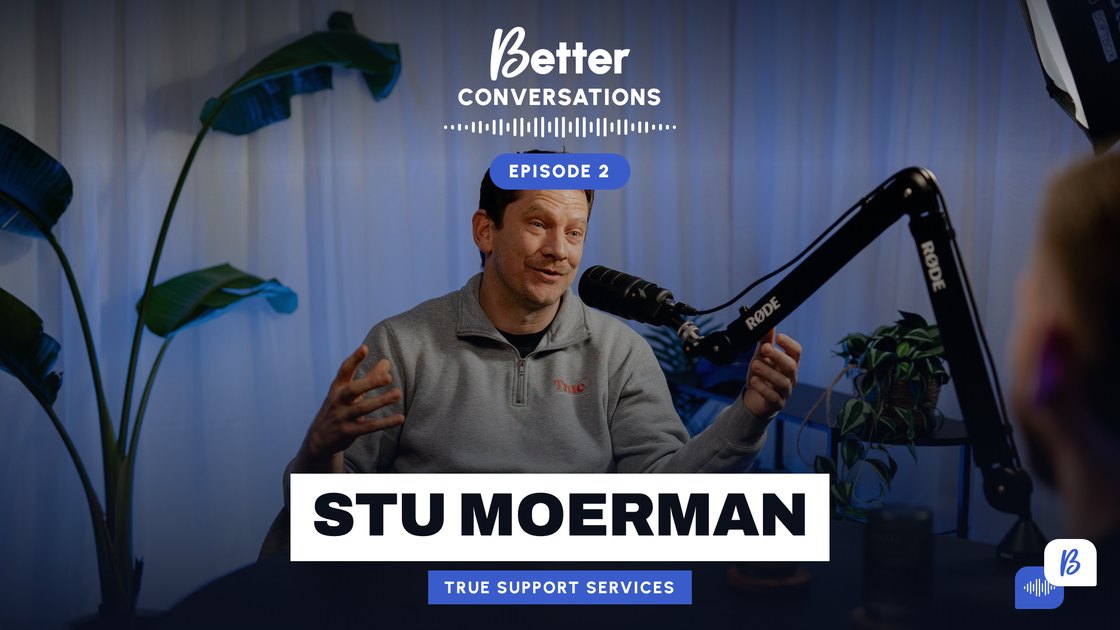
Episode 2
A hard heart and a soft heart
Stu Moerman, Director, True Support Services
Twenty years working with young people, and a plain answer to why the average youth worker lasts two.
A note before you listen. This conversation includes discussion of childhood trauma, child protection and out of home care, homelessness, substance use, and a brief reference to thoughts of self harm. Nothing is described in detail, but it is there from about 31 minutes in.
Chapters
Jump to the part you came for
Every timestamp opens the episode on YouTube at that moment.
- 00:00 Cold open and introductions Who Stu is, and what True Support Services does: mentoring for young people aged 7 to 25.
- 01:15 Twenty years: guardianship, residential care and homelessness Anglicare, six years at DCP in residential care, then seven years managing a youth homeless shelter.
- 04:23 Close to burnout, and meeting Max Stu had started a teaching degree to get out. Then he met a youth worker who had stayed thirty years.
- 08:39 Starting True Support, by accident A redundancy, one 15 year old who needed a mentor, and a business that grew out of a favour.
- 16:21 Building a team around your weaknesses Admin is not his strength, so he scaffolds it. What he learned from a principal who did the same thing.
- 22:12 Trust, and what over-supervision actually costs "If I scrutinise every little thing you are doing, you are not developing as a mentor." Micromanaging as a retention problem.
- 25:13 Advice for coming into this work green Get alongside someone with real experience, and wrap it in a theoretical framework. Working with workers is a different job again.
- 29:10 The hard heart and the soft heart The line the episode hangs on, and the two year average that follows from getting it wrong.
- 32:11 Crossed lines, and what the service actually is Handing a young person your phone number, and why "you are not their parent, you are not their friend" is the kinder position.
- 35:17 Falling through the cracks, and one good adult Two young people from the same system, twenty years apart in outcome, and the Harvard finding Stu builds his practice on.
- 45:45 The reforms, from someone who has seen the cycle before Four rounds of funding reform in twenty years, what actually changes, and where to find True Support.
Chapters were derived from the episode transcript and each start time was checked against the transcript before it was published here. Times refer to the full episode as posted on YouTube.
About this episode
What is in this one
Stu Moerman has been working with young people for more than twenty years. He started as a youth worker with Anglicare, spent six years in residential care with the state child protection agency, then seven years running a youth homeless shelter for the Salvation Army. True Support Services, the NDIS provider he now directs, grew out of one mentoring shift he agreed to do as a favour after his whole team was made redundant.
The idea the conversation keeps returning to is a simple one he tells his own staff.
"In this industry, you need to have a hard heart and you need to have a soft heart. You need a soft heart because you need to care about people. You need a hard heart because you need to switch off."
That sounds cold until he attaches the reason. The average youth worker lasts about two years, and in Stu's account it is usually the ones who care hardest who go first. They give a young person their personal number, they carry the crisis home, and within two years they are burnt out and resentful. His argument is that the boundary is not the opposite of care, it is what makes the care last long enough to matter.
Leadership by trust rather than supervision
The same principle shows up in how he runs a team. Stu describes himself as close to the opposite of a micromanager, possibly to a fault, and puts a cost on the alternative: a worker who is corrected on every detail never builds the judgement the job needs, and leaves. The line he uses is that if his staff mentor people the same way he does, something has gone wrong, because a mentor who does not bring their own personality will never build trust with the person in front of them.
Two young people, and what changed
The most difficult stretch of the conversation is two stories from his time in residential care and homelessness. One is a young girl who went two crucial years without a social worker, fell through the gaps and whom he later met on the street in Salisbury. The other is a young man who came into the shelter disengaged and drawing, and who now has stable housing, a long term partner and work as a graphic designer. Stu draws a line from both to a Harvard finding he says underpins everything he does: one good adult in a young person's life is among the strongest predictors of positive outcomes. His word for what that adult provides is margin.
On the reforms
The episode was recorded as major NDIS changes were coming through. Stu has worked in government funded programs his whole career and has watched several rounds of restructuring. His answer is not a hot take. He expects to stay nimble, possibly scale back, and keep going, and his stated worry is not the business but the participants who could be thrown out with the bathwater.

Recording context
How this one was recorded
Recorded in person in Adelaide in a single sitting, with video and audio captured together. Nothing was scripted and very little was cut.
Stu and Jackson have known each other for years. Jackson worked for Stu at True Support for about eighteen months before starting Better Support SA, which is why the conversation moves quickly past the introductions and why some of the harder questions get a straight answer. That history is worth knowing going in, because it shapes the tone of the whole hour.
The people in this episode
Host and guest

Jackson Morton
Host · Company Director, Better Support SAJackson runs Better Support SA, an NDIS provider in Adelaide, and still works directly with the young people it supports. He started this podcast because most of what he learned about running a service well came from conversations like this one, and almost none of it was written down.

Stu Moerman
Guest · Director, True Support ServicesA youth worker by trade with more than twenty years in the field, across guardianship programs, residential care, youth homelessness and a school wellbeing department. True Support Services provides mentoring to young people aged 7 to 25, and also runs True Music and a True Art Club.
True Support website and Instagram links to confirm. In the episode Stu says the site is truesupport.com.au and Jackson says truesupportservices.com, so the correct one needs checking before this is linked.